“It does not illustrate. It is the sensation of its own realization.”

RIP Cy Twombly

Each line was “the actual experience” of making the line.

Could Twombly be thought of as a Phenomenological painter?

I’ll admit, when I lived in Philadelphia, my least favorite room in the art museum there was the Cy Twombly room. It was hard to appreciate.

But nowadays, I almost view Twombly’s work as I view a tree.  To see a tree is to feel it reaching for the sun light, encapsulating its growth in its very form.

I came across this Kandinsky quote recently:

…I see no essential difference between a line one calls ‘abstract’ and a fish. But rather an essential likeness. This isolated line and the isolated fish alike are living beings with forces peculiar to them, though latent. They are forces of expression for these beings and of expression on human beings, because each has an impressive ‘look’ which manifests itself by its expression. But the voice of these latent forces is faint and limited. It is the environment of the line and the fish that brings about a miracle: the latent forces awaken, the expression becomes radiant… …The environment is the composition. The composition is the organized sum of the interior functions (expressions) of every part of the work. (Paris, March 1935)
Kandinsky, from “Artists on Art – from the 14th – 20th centuries”, ed. by Robert Goldwater and Marco Treves; Pantheon Books, 1972, London, p. 451 

It seems like Twombly found a way to close the distance between the act of painting and his paintings themselves, without pretense.

This is incredibly difficult to do.

I will look for Twombly paintings here in NYC.

Landscape Perception and Inhabiting Vision: Practising to see from the inside

From the recent archives, I thought it would be good to post my dissertation from Dartington. Download the pdf of Landscape Perception and Inhabiting Vision.

The Abstract:

In this dissertation I investigate vision and landscape through painting. I identify landscape as a diverse and lively critical field of study as I have come to understand it through my reading. I recognise that a problem occurs between my painting practice and my understanding of landscape as a lived practice. Vision has a deeply rooted epistemology of detached observation and an ecological practice requires engagement. To continue painting landscapes, I must find a way to inhabit vision.

I begin by comparing landscape as a way of seeing (Cosgrove 1998) with a phenomenologically placed account of dwelling-in-the world (Ingold 2000). I explore how vision in a landscape operates in both accounts. Of the two models, dwelling presents a more ecologically engaging account of living within the landscape, but it seems to advocate more immersive bodily experience (i.e. movement, touch, smell or hearing) and has no place for a detached vision. Must vision always be constituted by detached observation? I turn to Merleau-Ponty’s phenomenology in order to come to an understanding of embodied vision. In doing so, my conceptualisation of practice and method has changed. I find a theoretical framework that will support future inquiries into living and painting as an inhabitant of my landscape.

Walk through a field barefoot.

Today, after swimming in the Dart River, I walked barefoot up a sloped field to get to Dartington College of Arts.  (The shell of what is left there)  I found it very interesting that the field was sporadically covered in thorny plants that hurt my feet.  I thought about the cows that normally graze on this field and how they probably don’t like to eat the thorny plants.  A mechanical lawn mower wouldn’t mind thorny plants.  I wouldn’t have noticed them if I wore boots.  I tip-toed through this field, avoiding prickles where I could—marveling at the way the field was shaping my trek across it. Was the grazed grass my infrastructure, provided by the cows? Are the thorny plants encroaching ‘nature’ or are they arising specifically because of the grazed grass? Barefoot, I weaved my way through this entwined patchwork of land, shaped by human practices yet shaping my path.

I still have a few thorns in my feet as I get ready to sleep.

Representation of Space in Space

I’ve been reading Edward Soja’s Thirdspace (1996) and Postmodern Geographies (1989) and Perceptions of the Environment (2000) by Tim Ingold.

“Space hides consequence from us now.”  (Berger in Soja 1989 p.22)

Space does hide consequence from those who have power..  We throw out rubbish and it goes ‘somewhere.’  We use electricity that comes from ‘somewhere.’  Our food in the super-markets comes from ‘somewhere.’  The western life-style and model of consumption is propped up on patterns that have real world spatial consequences that we do not typically see.  Many people live with these consequences and learn to find opportunity, however slim.

“…social relations become real and concrete, a part of our lived social existence, only when they are spatially “inscribed” –that is, concretely represented–in the social production of social space.”    ( Soja 1996  p46)

My experience in Pittsburgh and Philadelphia was largely influenced by a post-industrial condition. It could be argued that the factories first stood a consequence of a particular mode of production. But then the ruins of the old factories seem to become more complicated. Ambivalence about the future of the space prevails,  an absence of belief in industry for the community takes hold as the factories somehow seem to become symbols of extraction instead of production. The structures atrophy as space hides the consequences of a globalized industrial world elsewhere.

“By the same token, it is also man developing into nature.  Or in other words, human actions in the environment are better seen as incorporative than inscriptive, in the sense they are built or enfolded into the forms of the landscape and its living inhabitants by way of their own processes of growth.” (Ingold p. 87)

[singlepic id=70 w=400 h=300 float=center]In Totnes, I find that this process of incorporating social relations into the landscape is on a larger time scale. Eventually ruins become the new norm. Before last fall, I was incredibly short sighted. The history of the US in the landscape is a few hundred years at best. Here in South Devon, the area is deemed an Area_of_Outstanding_Natural_Beauty, which has been confusing to say the least. Culturally, it is considered natural, but many forests can be plantations, many fields are enclosed and grazed. Even Dartmoor, the neighboring national park has a longstanding history of military use.

Show Time Again. The Countdown Begins.

It is roughly 100 days until the MA show here at the Dartington Campus of the University College Falmouth.  It is a very strange experience—the Dartington Campus will move to the main college at the end of the year.  There is a definitive sense of a winding down of place happening here that is both unique in the perspective it brings, and a bit of a burden.

I am preparing for another suite of paintings, trying to continue with the theme of painting landscapes where something is missing.  In recent work, this has been mainly centered around the post-industrial condition, but that specific land condition is slim Totnes.  I am attracted to the idea of an implied narrative through depicting an absence and how painting a local landscape can evoke discussion of simultaneous experiences of place.

In Space and Place: The Perspective of Human Experience, Yi Fu Tuan is discussing intimate experiences of place.  Calling places “centers of value” (Tuan, p.18); the sense of place is developed by an accumulation of everyday events.  Yet, intimate experiences are elusive to descriptive language.

Pictorial art and rituals supplement language by depicting areas of experience that words fail to frame; their use and effectiveness again vary from people to people.  Art makes images of feeling so that feeling is accessible to contemplation and thought.  Social chatter and formulaic communication, in contrast, numb sensitivity. Even intimate feelings are more capable of being represented than most people realize. The images of place, here sampled, are evoked by the imagination of perceptive writers. (namely an Isherwood passage) By the light of their art we are privileged to savor experiences that would otherwise have faded beyond recall. Here is a seeming paradox: thought creates distance and destroys the immediacy of direct experience, yet it is by thoughtful reflection that the elusive moments of the past draw near to us in a present reality and gain a measure of permanence.

(Ibid, p. 148)

Some potential sites that I will paint for the MA show include:

  • A former, now vacant, squat near my flat.  Squatters were evicted by court order.  Landlord came in and smashed up the plumbing in an effort to make the places uninhabitable.
  • A former forest that has just been logged by the forestry service. Neighbors are upset.
  • A former quarry that is not used now, roped off for fear of falling rocks.
  • A former swimming pool on the Dartington Estate, next to an abandoned school and tennis court.

I am still scouting around for further ideas. The above quote resonates with my approach to my current landscape painting work, specifically the last aspect. I believe I am trying to crystallize spaces that are fading or shine light on spaces that are hiding consequences.

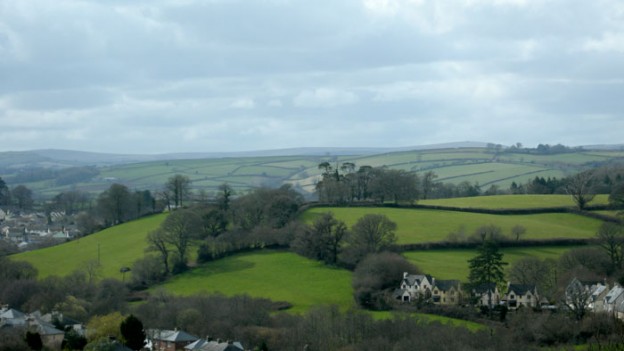
Is it possible to have an intimate experience of the views here in Totnes? I am confounded on how to interpret the land from this perspective. I want to paint the vista’s because, I mean wow.  How to frame it?  Below is not natural, it is a beautiful landscape with an absence of the signs of  labor that shaped it.  What will this land look like when it starts to return to forest?  Perhaps that is one way to try to paint it.

View of the area around Totnes from the Castle

View of the area around Totnes from the Castle

Tuan, Y. (2003) Space and Place : The Perspective of Experience. Minneapolis: University of Minnesota Press.

Disembodied and Engaged Aesthetics

As a painter in a Master’s course for Arts and Ecology, I am to produce a written work that attempts to synthesize my interests.  My hope is to hash out ideas and get my writing chops up right here on this page.  I had recently read Aesthetics & Nature, and wrote briefly about aesthetics.

Aesthetics & Nature by Glenn Parsons begins with a presupposition that it “has become clear that some aspects of our relationship to nature pose significant problems for nature and for us” (Parsons, 2008, p. ix).  Appreciating the beauty of natural place can be a path toward care and respect that may reshape that relationship.  Parsons argues against the term ‘beauty’ in favor aesthetic quality, which is defined as as “a visual or auditory appearance that is pleasing or displeasing for its own sake” (Ibid. p.17). As a painter, I take a formal interest in facilitating an aesthetic experience.  Conceptually, I am concerned with how or when a space can become a place.  I explore the multiple narratives behind connectionsto place through the sites I choose.  I believe aesthetics play a role in creating connections to place.  I present my paintings as an aesthetic experience that I hope invokes conversations and reflections about place, and in turn, contributes to the construction of new value systems to inform more responsible ecological decisions.

Disembodied Aesthetics

In chapter six, Parsons investigates the implications of restricting aesthetic perception to vision or hearing.  The visual or auditory senses imply a physical distance between the perceived object and the perceiver.  One appreciates a vista or a painting from an optimal distance.  Touch, smell, and taste, by contrast, require a more immediate interaction between the perceiving body and the object.  (This notion of distance and proximity across the senses requires an in-depth exploration beyond the scope of this paper.)  The disembodied aesthetic, “in which we are to avoid getting too close to things, or becoming too physically involved with them” (Ibid. p. 82), is a pleasure not felt in any direct region of the body, i.e., visual and auditory.  Parsons then shows the complications of an immersive experience where that distance is more difficult to achieve and discusses Arnold Berleant’s ‘aestheticsof engagement’ as an alternative framework.

Engaged Aesthetics

Aesthetic appreciation on the St. Ives coast during a storm in November 2009

What this means is that the object of appreciation, as a separate and distinct thing, dissolves away, becoming inextricably mingled with the perceiver. What I appreciate is not so much an object, then, as an experience that encompasses both me and the object in an inseparable whole.

(Ibid. p. 85)

To achieve this perceptual unity, “a diminishment of thinking seems capable of enhancing our degree of engagement with nature, perhaps even necessary for such engagement” (Ibid. p. 88).  This diminishment of thinking promotes a dissolution of the self and other.  Because of this dissolution, linguistic description of an engaged state proves difficult.

The ‘inseparable whole’ is an attractive idea for a more ecologically-based approach to nature.  In fact, the very term ‘nature’ is under dispute, as the humans are a part of nature and it may seem artificial to differentiate between then.   This separation has proved useful to us during the industrial revolution, where nature had been thought of as the other, a resource to extract and discard. Dissolving that difference would promote responsibility over the health of ecological systems, for if we are indistinguishable from our environment, we would take better care of it.  Yet Parsons argues, “abandoning the concept of nature, however would be a very unfortunate move, because doing so would rob us of an extremely useful concept” (Ibid. p,3).  He believes the term gives us language to describe natural processes that are distinct from human activities.  To this end, thought and language play an important role in our collective discourse and are significant obstacles to an aesthetic of engagement.  “(H)ow does one convey the nature, much less the value, of the experience of engagement to other people” (Ibid. p.90) when the very form resists linguistic description and diminishes thought?

The engaged aesthetic involves the senses in a way that could provide a rich and more sensual experience with the natural world.  In this way it appears similar to phenomenology.  Embodiment in the engaged aesthetic seems to value the individual perspective and experience over the collective. The notion of shared experience is important in considering relationships to the natural world and I am interested in ways of exploring the positive attributes of this approach while considering concerns of the pubic realm.

Engaged aesthetics is an interesting idea for a practice of observational painting, especially from a plein air perspective.  Some of the best moments when I paint are comprised of diminished thinking (ha!) and an enhanced sense of engagement with the observed subject.  The engaged state may refuse linguistic description, but it may prove beneficial to creating a compelling painting.  Non-representational theory can provide further depth in contextualizing observational painting with engaged aesthetics:

In other words, the act of representing (speaking, painting, writing) is understood by non-representational theory to be in and of the world of embodied practice and performance…the world is understood to be continually in the making—processual and performative—rather than stabilised or structured via messages in texts and images.

(Wylie, 2007, p164)

Parsons concludes that “the notion of engagement seems incapable of serving as a basis for a definition of the aesthetic” (Parsons, 2008, p.93) by explaining that aesthetic experience is possible without the sense of unity that engagement would require.  I am interested in exploring the particular of an engaged aesthetic and how it alters the boundaries or distances between subject and object.

Pirate Utopia in the Presence of High Way Desolation

Last night, in Philadelphia, I fell into a Pirate Utopia entirely enabled by the construction of I-95. It was 2 a.m. in the morning and we played music loud with the front door open. The rest of the buildings on the block had long since crumbled away from the negative effect of the huge berm of the highway. My friends were completely comfortable throwing beer bottles over onto that berm, saying that “it doesn’t matter- no body comes here!” and “Boy, isn’t that liberating to throw the bottle? When is the last time you did that?” At the same time, they commented they saw a skunk walking along that overgrown edge of the highway. I thought the skunk was the most important aspect and wondered how to make that something to care about. “Who knew there where skunks in Fishtown?”

There was a frame of a new building on the block and it was easy to enter and explore. I was hesitant at first, and then realized I was in a space that the police would not care about. I was in a space that a select few people care about and yet, 180,000 automobiles pass daily. So I joined my fellow musicians and climbed up to the top of the building.

I could see the sky scrapers of Philadelphia in the distance. I could see the lights on top, pulsing, presumably to alert planes of their presence but I am not sure. The visual vector of i-95 led directly to them, and I couldn’t help but see the highway as a pulse of the city as an organism. I looked around at the row houses and tried to view the landscape as it would appear 10 years ago, 30 years ago or 50 years ago. I looked at the trees and tried to reverse their growth. I tried to remove the highway, the huge barrier it presented both physically and mentally. I saw the Delaware River in the distance and the non-linear aspects of progress.  I cherished the newness of the experience and the perspective it gave me, simply to be elevated above my neighborhood in an unclaimed space. We turned a big banner selling something backwards with a “Now who’s selling what?”

It was an escape from the escape we live in. It felt real.